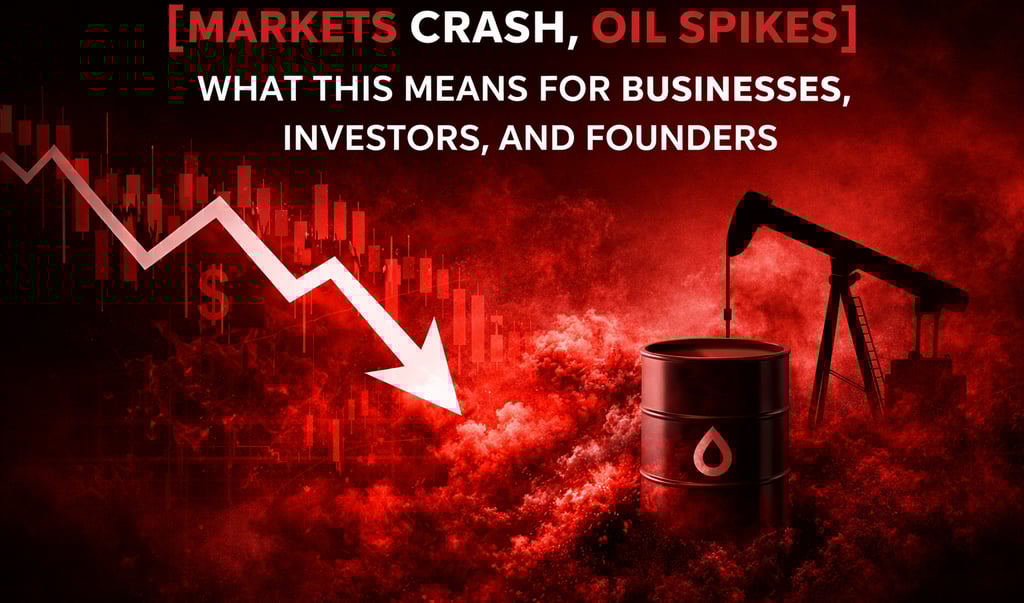
Markets Crash, Oil Spikes: What This Means for Businesses, Investors, and Founders
Global markets don’t move in isolation. They react—often sharply—to uncertainty. Right now, we’re witnessing a familiar but powerful combination: 📉 Stock markets sliding 📈 Oil prices surging Whenever these two events happen simultaneously, it signals more than just short-term volatility. It points toward deeper structural concerns—geopolitical risks, inflation pressure, and economic recalibration. Let’s break down what’s happening and what it actually means.
Markets Crash, Oil Spikes: What This Means for Businesses, Investors, and Founders
Global markets don’t move in isolation. They react—often sharply—to uncertainty.
Right now, we’re witnessing a familiar but powerful combination:
📉 Stock markets sliding
📈 Oil prices surging
Whenever these two events happen simultaneously, it signals more than just short-term volatility. It points toward deeper structural concerns—geopolitical risks, inflation pressure, and economic recalibration.
Let’s break down what’s happening and what it actually means.
Why Are Markets Falling?
Financial markets are forward-looking. They don’t wait for crises to fully unfold—they price in expectations.
Markets typically fall when investors anticipate:
Escalating geopolitical tensions
Disruptions in global trade routes
Sanctions or supply-chain blockages
Inflationary pressure
Slower economic growth
Uncertainty increases perceived risk. And when risk rises, capital flows out of equities and into safer assets like gold, bonds, or cash positions.
This isn’t panic. It’s risk management at scale.
Why Is Oil Spiking?
Oil is one of the most geopolitically sensitive commodities in the world.
If supply from major oil-producing regions is threatened—whether due to conflict, sanctions, shipping disruptions, or production cuts—markets immediately adjust prices upward.
Higher oil prices have a ripple effect across the global economy:
Transportation becomes more expensive
Manufacturing costs increase
Logistics margins shrink
Airlines face cost pressure
Consumer goods prices rise
In short, oil acts like a multiplier for inflation.
And inflation is something central banks actively fight—often by raising interest rates. That’s where the pressure on stock markets intensifies.
The Inflation Domino Effect
When oil prices spike:
Businesses face higher operating costs
Consumers experience price increases
Spending slows
Corporate earnings forecasts get revised downward
Equity valuations adjust
Markets fall not because today is bad—but because tomorrow may become more expensive.
What This Means for Businesses
For business owners and founders, this is not just financial news—it directly affects strategy.
Here’s how:
1. Advertising & Marketing Budgets
When uncertainty rises, companies often cut discretionary spending first—and marketing budgets are frequently impacted.
But history shows something important:
Brands that maintain strategic visibility during downturns often capture greater market share long-term.
2. Consumer Behaviour Shifts
Consumers become more cautious.
Value-driven messaging outperforms luxury positioning during high inflation periods.
3. Cash Flow Becomes Critical
Access to capital tightens when markets fall.
Investors become selective.
Profitability and efficiency gain importance over aggressive expansion.
What This Means for Investors
Volatility creates discomfort—but also opportunity.
Market corrections reset valuations.
Strong companies with solid fundamentals often emerge stronger once stability returns.
The key distinction is between:
Short-term fear
Long-term structural weakness
Not every drop signals a crisis. Some signal recalibration.
The Founder’s Perspective: How to Respond
Periods like this separate reactive leadership from strategic leadership.
Instead of panic, smart founders focus on:
✔ Strengthening balance sheets
✔ Optimizing operational efficiency
✔ Protecting margins
✔ Re-evaluating cost structures
✔ Doubling down on customer retention
✔ Strengthening brand trust
Economic cycles are inevitable.
Preparation is optional.
The Bigger Picture
Markets move in cycles.
Oil fluctuates.
Geopolitics evolves.
Central banks adjust.
Economies recalibrate.
But innovation doesn’t stop.
Demand doesn’t disappear.
Businesses don’t vanish overnight.
They adapt.
History shows that some of the strongest companies were built during uncertain times—because disciplined strategy beats emotional reaction.
That's A Wrap!
Markets crashing and oil spiking are signals—not conclusions.
Signals of shifting risk.
Signals of recalibration.
Signals that strategy matters more than sentiment.
If you're building, investing, or scaling right now—focus on fundamentals.
Volatility doesn’t eliminate opportunity.
It redistributes it.
Ready to Scale Your Brand Online?
Your audience is already searching online; let’s make sure they find your business first.
At ScaleUp Marketing Solutions, we help brands grow through SEO, social media marketing, content, branding, and digital strategies designed to increase visibility, traffic, and conversions.
Quick Links
Contact Us
Call: +91-9926753404
Email: contact@sumsmarketing.com
partner@sumsmarketing.com
WhatsApp us here