
How I Ranked My Website on Google in 33 Days (SEO Case Study)
Learn how I ranked my website on Google in just 33 days using ChatGPT and simple technical SEO fixes like schema markup, FAQs, canonical tags, robots.txt, and proper site structure.
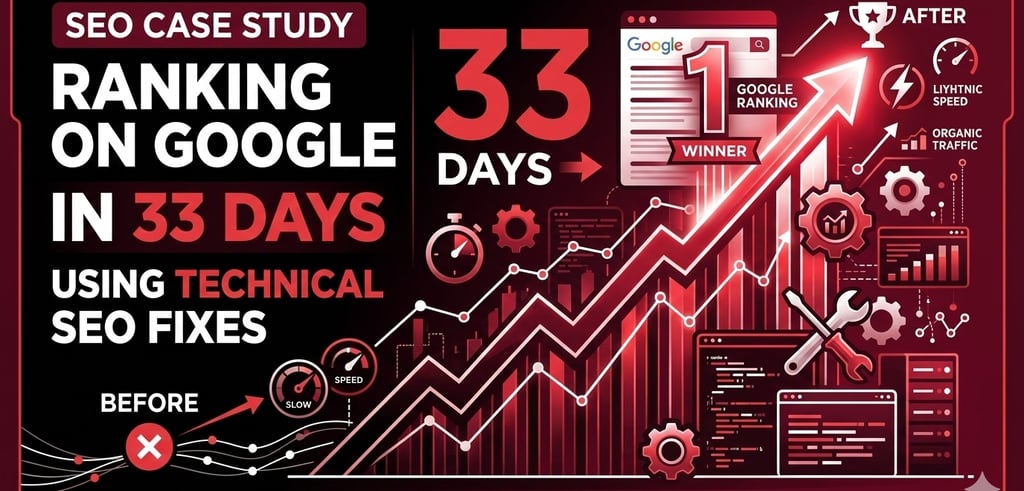
How I Ranked My Website on Google in 33 Days Using ChatGPT and Basic SEO Fixes
Many businesses believe ranking on Google takes months or even years.
While SEO is definitely a long-term strategy, sometimes the biggest improvements come from fixing the basics that many websites overlook.
After spending 8 years in digital marketing helping clients rank their websites on Google, I realized something ironic—my own website wasn’t ranking properly.
The reason?
It was being managed by someone else, and several fundamental SEO issues were silently affecting performance.
So, I decided to rebuild everything from scratch and take full control of my website's SEO.
Within 33 days, my website started appearing on Google search results.
Here’s exactly what I did.
Step 1: Rebuilding the Website From Scratch
The first step was taking complete ownership of the website.
Previously, the site was hosted on WordPress and maintained by someone else. Once I noticed basic technical issues, I decided to rebuild everything properly.
I moved the website to Hostinger, where I could manage every aspect of the site myself.
I also made an important change — the domain name.
My earlier domain was:
scaleupmarketingsolutions dot com
While descriptive, it was too long and not ideal for branding or SEO.
So I shortened it to:
Shorter domains are easier to remember, easier to type, and often perform better in branding and marketing.
Step 2: Fixing the Most Important Technical SEO Basics
Many websites fail to rank not because of content issues but because technical SEO fundamentals are missing or poorly implemented.
In the first week, I focused only on fixing the foundation.
These were some of the key fixes:
1. Implementing Schema Markup
Structured data helps search engines better understand your website.
I implemented:
Person Schema
Organization Schema
FAQ Schema
Schema markup improves search visibility and can help websites appear with rich results in Google search.
2. Adding FAQ Sections With Schema
One strategy I applied across almost every page was adding FAQ sections with schema markup.
FAQs help in two major ways:
They answer user questions directly
They increase the chances of appearing in rich results
Many websites ignore this opportunity.
But search engines prefer content that directly addresses user queries.
3. Setting Up Favicon Properly
A favicon may seem small, but it helps with:
brand identity in browser tabs
recognition in bookmarks
search appearance in some browsers
Small details like this contribute to overall website credibility.
4. Fixing Canonical Tags
Canonical tags tell search engines which version of a page should be indexed.
Without proper canonical tags, websites can suffer from:
duplicate content issues
diluted ranking signals
indexing confusion
Fixing this ensures search engines understand the primary version of each page.
5. Optimizing Robots.txt
The robots.txt file helps control how search engines crawl your website.
I made sure:
important pages were crawlable
unnecessary pages were blocked
search engines could easily access key content
This improves crawl efficiency and indexing.
6. Correct Header Hierarchy
Many websites misuse headings.
A proper structure looks like this:
H1 for main page title
H2 for main sections
H3 for subtopics
This helps both search engines and users understand the content structure.
Step 3: Designing Every Page Manually
Instead of relying heavily on automated templates, I designed each page manually.
This helped me understand:
what elements existed on each page
what SEO improvements were needed
where internal linking could be added
how content should be structured
When you build your pages yourself, you gain a deeper understanding of your website architecture and SEO strategy.
Step 4: Trusting the SEO Process
Throughout the process, I kept questioning the results.
Many times I asked ChatGPT:
“Are you sure this will work?”
The answer was always simple.
Trust the process.
At one point, I even argued that many websites ranking on Google don’t follow all these SEO basics.
But the reality is:
Just because some websites rank despite mistakes doesn't mean those mistakes should be repeated.
Strong SEO is about building a solid foundation first.
Step 5: The Results After 33 Days
After applying these improvements and continuously working on the website, results started appearing within 33 days.
The website began showing up in Google search results.
No shortcuts.
No spam tactics.
No black hat SEO.
Just:
technical SEO fixes
proper structure
consistent improvements
The Biggest SEO Lesson I Learned
The biggest realization during this process was something simple.
I already knew these SEO fundamentals.
After 8 years in marketing, I had applied them for many clients.
But I wasn't applying them properly to my own website.
Sometimes success in marketing isn’t about discovering a new secret technique.
It’s about finally applying the basics consistently.
That's a wrap!
If your website is not ranking on Google, the problem may not be complex.
Often it comes down to missing technical SEO fundamentals.
Before chasing advanced strategies, make sure your website has:
proper schema markup
optimized robots.txt
canonical tags
structured headings
FAQ sections
strong technical foundation
SEO success begins with getting the basics right.
And sometimes, those basics can make a huge difference faster than you expect
Ready to Scale Your Brand Online?
Your audience is already searching online; let’s make sure they find your business first.
At ScaleUp Marketing Solutions, we help brands grow through SEO, social media marketing, content, branding, and digital strategies designed to increase visibility, traffic, and conversions.
Quick Links
Contact Us
Call: +91-9926753404
Email: contact@sumsmarketing.com
partner@sumsmarketing.com
WhatsApp us here